
ICC CAS has made significant progress in the structural regulation of iron-based catalysts
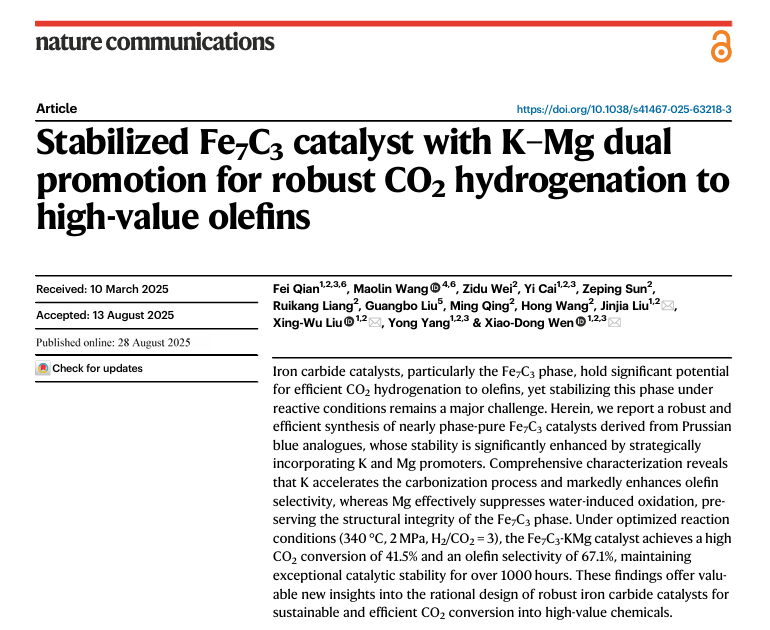
Recently, a team led by Researcher Wen Xiaodong from the Institute of Coal Chemistry (ICC) of the Chinese Academy of Sciences (CAS) has made significant progress in the structural regulation of iron-based catalysts. The research result, titled "Stabilized Fe7C3 Catalyst with K-Mg Dual Promotion for Robust CO2 Hydrogenation to High-Value Olefins" is published in Nature Communications.
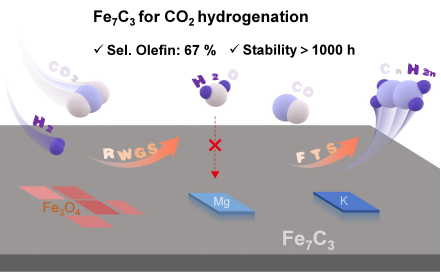
ABSTRACT: Iron carbide catalysts, particularly the Fe7C3 phase, hold significant potential for efficient CO2 hydrogenation to olefins, yet stabilizing this phase under reactive conditions remains a major challenge. Herein, we report a robust and efficient synthesis of nearly phase-pure Fe7C3 catalysts derived from Prussian blue analogues, whose stability is significantly enhanced by strategically incorporating K and Mg promoters. Comprehensive characterization reveals that K accelerates the carbonization process and markedly enhances olefin selectivity, whereas Mg effectively suppresses water-induced oxidation, preserving the structural integrity of the Fe7C3 phase. Under optimized reaction conditions (340 °C, 2 MPa, H2/CO2 = 3), the Fe7C3-KMg catalyst achieves a high CO2 conversion of 41.5% and an olefin selectivity of 67.1%, maintaining exceptional catalytic stability for over 1000 hours. These findings offer valuable new insights into the rational design of robust iron carbide catalysts for sustainable and efficient CO2 conversion into high-value chemicals.
Qian, F., Wang, M., Wei, Z. et al. Stabilized Fe7C3 catalyst with K–Mg dual promotion for robust CO2 hydrogenation to high-value olefins. Nat Commun 16, 8044 (2025). https://doi.org/10.1038/s41467-025-63218-3
© Institute of Coal Chemistry, Chinese Academy of Sciences, All Rights Reserved
Address: 27 South Taoyuan Road, Taiyuan, Shanxi, P.R.China
Tel: (86)351-4041627 Email: sxicc_en@sxicc.ac.cn
