
ICC CAS has made significant progress in the hydrogenation of CO2 to produce light olefins
Recently, a team led by Prof. Weibin Fan and Prof. Sen Wang from the Institute of Coal Chemistry (ICC) of the Chinese Academy of Sciences (CAS), in collaboration with Prof. Xuning Li from the Dalian Institute of Chemical Physics and Prof.Unni Olsbye from the University of Oslo in Norway, has made significant progress in the hydrogenation of CO2 to prepare light olefins. This achievement was published in the top international Journal "Journal of the American Chemical Society". The research outcome is titled "Enhancement of CO2 Hydrogenation to Light Olefins by Developing a Higher Alcohols-Intermediate Route". The first author and the first institution of the paper are both ICC CAS.
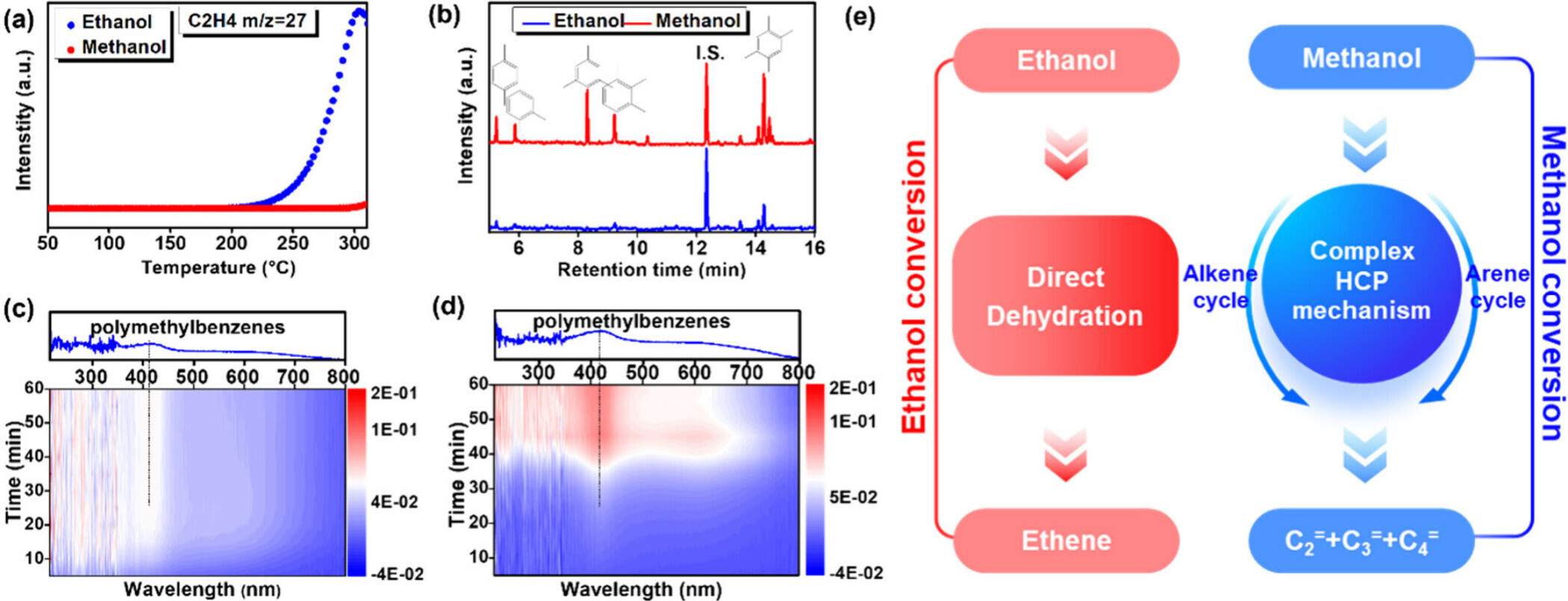
ABSTRACT: CO2 hydrogenation to light olefins generally occurs via Fischer−Tropsch (FT) synthesis and methanol-intermediate routes. However, these two routes usually give low light olefin yields, although large numbers of catalysts have been fabricated. This results from the limitation of the Anderson−Schulz−Flory (ASF) law or the formation of initial C−C bond and hydrocarbon pool (HCP) species. To overcome these problems, a higher alcohol-intermediate route is developed here as these alcoholic products are rapidly dehydrated to light olefins. The designed Na-CuFeOx/H-GeAPO-34 composite shows CO2 conversion of 75.1% and light olefins selectivity in all products (including CO) of 48.7%, thus resulting in an unprecedentedly high yield of 36.6%. In situ spectroscopy and DFT calculation results reveal that the metallic copper (Cu) species not only promotes iron (Fe) species reduction and carbonization by overflowing active hydrogen species and transferring electrons but also provides an effective site for stabilizing nondissociative CO* species. This enhances formation of CHx* and nondissociative CO* species, which are coupled to generate large amounts of higher alcohols intermediates that are facilely dehydrated into light olefins on weakly acidic H-GeAPO-34. This work confirms that the higher alcohols-intermediate route is highly effective for converting CO2 into light olefins.
Qian Zhang, Xiyu Li, Shifu Wang, Sen Wang, Rui Geng, Pengfei Wang, Mei Dong, Jiangang Chen, Jianguo Wang, Xuning Li, Unni Olsbye, and Weibin Fan, Journal of the American Chemical Society Article ASAP, DOI: 10.1021/jacs.5c13493
© Institute of Coal Chemistry, Chinese Academy of Sciences, All Rights Reserved
Address: 27 South Taoyuan Road, Taiyuan, Shanxi, P.R.China
Tel: (86)351-4041627 Email: sxicc_en@sxicc.ac.cn
